

 Beginning in the 1840s, dentists discovered that, after they had removed the decay from a tooth, they could create an amalgam of mercury and silver that would harden into a long-lasting filling. This amalgam, made up of about 50 percent mercury, has since saved countless teeth. But beginning in the 1980s advances in materials and bonding technology made white composite fillings possible. And while the American Dental Association maintains that mercury and silver amalgam fillings are safe, many patients are concerned about having mercury in their mouths and in the mouths of their children. Dr. Dennis became a mercury-free dentist to address these concerns.
Why People Choose a Mercury-Free Dentist
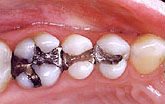 Dentists like Dr. Dennis offer mercury-free dentistry in part to take advantage of the benefits white composite fillings. Although many people think that the only benefit they offer is cosmetic, composite fillings are actually bonded to the tooth surface where decay has been removed. This strengthens the teeth, providing protection from the possibility of breakage, while mercury amalgam fillings tend to weaken the teeth they fill. The illustrations above and below show the same three teeth filled first with the silver and mercury amalgam fillings, and then with white composite fillings.
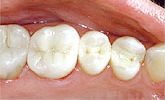 In addition, white composite fillings preserve more of the natural tooth structure, because the drilling required to place an amalgam filling is more extensive than that required for a composite filling. And composite fillings also seal adjacent parts of the tooth to prevent further decay, and they produce less tooth sensitivity than amalgam fillings
What is Sanitary Amalgam Removal?
For patients concerned about mercury in their fillings, the question of how to replace them becomes important. If they are simply drilled out, a lot of dust and debris is created, which can easily be swallowed or breathed in. To address this concern, Dr. Dennis provides sanitary amalgam removal. This means that she isolates the tooth with a sealed rubber barrier and uses highly effective suction equipment so you don’t breathe in or swallow any mercury.
Choosing the Right Mercury-Free Dentist
Although many dentists, starting in the 1980s, became excited about the new technology that made white composite fillings possible, dental schools still prefer the “tried and true” method of placing mercury amalgam fillings. They don’t teach the advanced techniques required to bond composite fillings. This means that it is important to choose a dentist who, like Dr. Dennis, has taken the postgraduate training necessary to learn intricate bonding techniques. If they are not bonded properly, there is a risk of increased tooth sensitivity, and in some cases, they can crack and fall out.
As a member of the American Academy of Oral Systemic Health, Dr. Dennis is well aware that there is quite a lot of research that has demonstrated the link between dental health and many systemic disease conditions.